
A Homeowner's Guide to the Best Energy-Efficient Windows for Hot Climates
If you live where the summer sun does most of the damage, the rules for choosing windows are different than they are in the rest of the country. In cold climates, windows are judged mostly on how well they hold heat in. In hot climates like ours, the priority flips: the best window is the one that keeps the sun's heat out while still letting light in. Get that one distinction right and you can shave a meaningful amount off your cooling bill every summer — and keep your home comfortable through a Phoenix July or an El Paso August.
This guide explains, in plain terms, what actually makes a window energy-efficient in a hot climate, which numbers to look for on the label, and how to choose glass, panes, and frames that are built for our sun rather than someone else's snow.
A Homeowner's Guide to the Best Energy-Efficient Windows for Hot Climates
If you live where the summer sun does most of the damage, the rules for choosing windows are different than they are in the rest of the country. In cold climates, windows are judged mostly on how well they hold heat in. In hot climates like ours, the priority flips: the best window is the one that keeps the sun's heat out while still letting light in. Get that one distinction right and you can shave a meaningful amount off your cooling bill every summer — and keep your home comfortable through a Phoenix July or an El Paso August.
This guide explains, in plain terms, what actually makes a window energy-efficient in a hot climate, which numbers to look for on the label, and how to choose glass, panes, and frames that are built for our sun rather than someone else's snow.
What makes a window energy-efficient in a hot climate?
An energy-efficient window for a hot climate is one that blocks the sun's radiant heat before it enters your home, insulates against outdoor temperatures, and seals tightly against air leaks — without making your rooms dark.
Four things determine whether a window can do that:
- Solar Heat Gain Coefficient (SHGC) — how much of the sun's heat the window lets through. This is the single most important number in a hot climate.
- U-factor — how well the window insulates against heat flow. Lower is better.
- Low-E glass coating — a microscopically thin metallic layer that reflects heat and UV rays.
- Frame material and construction — some materials conduct heat into your home; others block it.
The rest of this guide walks through each one.
What makes a window energy-efficient in a hot climate?
An energy-efficient window for a hot climate is one that blocks the sun's radiant heat before it enters your home, insulates against outdoor temperatures, and seals tightly against air leaks — without making your rooms dark.
Four things determine whether a window can do that:
- Solar Heat Gain Coefficient (SHGC) — how much of the sun's heat the window lets through. This is the single most important number in a hot climate.
- U-factor — how well the window insulates against heat flow. Lower is better.
- Low-E glass coating — a microscopically thin metallic layer that reflects heat and UV rays.
- Frame material and construction — some materials conduct heat into your home; others block it.
The rest of this guide walks through each one.
What is SHGC, and why does it matter most in the desert?
Solar Heat Gain Coefficient (SHGC) is a number between 0 and 1 that measures how much solar heat passes through a window. A window with an SHGC of 0.23 lets in 23% of the sun's heat and blocks the other 77%. The lower the number, the cooler your home stays.
In a hot, sunny climate, SHGC matters more than any other rating. Every bit of solar heat that comes through your glass is heat your air conditioner then has to remove — so a low SHGC directly lowers your cooling costs. A window can have excellent insulation and still cook your living room if its SHGC is too high.
For homeowners in Tucson, Phoenix, Albuquerque, El Paso, and Southern California, a low SHGC is the first thing to look for. As a rule of thumb, aim for 0.25 or lower.
What is SHGC, and why does it matter most in the desert?
Solar Heat Gain Coefficient (SHGC) is a number between 0 and 1 that measures how much solar heat passes through a window. A window with an SHGC of 0.23 lets in 23% of the sun's heat and blocks the other 77%. The lower the number, the cooler your home stays.
In a hot, sunny climate, SHGC matters more than any other rating. Every bit of solar heat that comes through your glass is heat your air conditioner then has to remove — so a low SHGC directly lowers your cooling costs. A window can have excellent insulation and still cook your living room if its SHGC is too high.
For homeowners in Tucson, Phoenix, Albuquerque, El Paso, and Southern California, a low SHGC is the first thing to look for. As a rule of thumb, aim for 0.25 or lower.
What is U-factor, and how low should it be?
U-factor measures how well a window insulates — how easily heat flows through it. Like SHGC, lower is better, and it's usually a number between about 0.15 and 1.20.In the desert, U-factor matters most on the coldest winter nights and the hottest afternoons, when there's a big temperature gap between inside and outside. It's the second number to check after SHGC. For our region, look for a U-factor around 0.30 or lower.
| Your area | climate zone | Max U-factor | Max SHGC |
|---|---|---|---|
| Arizona, New Mexico, Southern California | Southern | 0.32 | 0.23 |
| West Texas (El Paso) | South-Central | 0.28 | 0.23 |
The U.S. Department of Energy's ENERGY STAR program divides the country into four climate zones and sets a performance target for each. The Window Depot's service area spans the two hottest zones.
Current ENERGY STAR Version 7.0 criteria, in effect since October 2023.
Notice that the SHGC target is the same (0.23 or lower) across our whole region — that's how much our climate is defined by the sun. A window that meets the ENERGY STAR standard for your zone is certified to keep out solar heat efficiently for exactly the conditions you live in.
Do Low-E windows really lower cooling bills?
Yes. Low-emissivity (Low-E) glass has an invisible metallic coating that reflects the sun's infrared heat and ultraviolet rays back outside while still letting visible light through. It's the single feature most responsible for a low SHGC, and in a sun-baked climate it's essential rather than optional.
Low-E glass does three things at once: it keeps radiant heat out in summer, blocks the UV rays that fade your floors, furniture, and artwork, and reduces glare. According to ENERGY STAR, replacing old single-pane windows with certified energy-efficient windows lowers a household's energy bills by an average of up to 13% nationwide — and in a cooling-dominated climate like ours, those savings show up mostly on your summer electric bill.
Do Low-E windows really lower cooling bills?
Yes. Low-emissivity (Low-E) glass has an invisible metallic coating that reflects the sun's infrared heat and ultraviolet rays back outside while still letting visible light through. It's the single feature most responsible for a low SHGC, and in a sun-baked climate it's essential rather than optional.
Low-E glass does three things at once: it keeps radiant heat out in summer, blocks the UV rays that fade your floors, furniture, and artwork, and reduces glare. According to ENERGY STAR, replacing old single-pane windows with certified energy-efficient windows lowers a household's energy bills by an average of up to 13% nationwide — and in a cooling-dominated climate like ours, those savings show up mostly on your summer electric bill.
CABINET HARDWARE AND FEATURES
Hardware and built-in features are easy to overlook when you are comparing quotes, but they shape both the daily experience and price.
- Soft-close hinges and drawer slides – quieter and gentler on the cabinets, now a popular standard
- Full-extension drawer slides – let you reach all the way to the back of every drawer
- Pull-out organizers, lazy Susans, and trash cabinets – add storage and everyday convenience
- Knobs and pulls – a small change that refreshes the look, available in finishes like satin nickel, matte black, bronze, and stainless steel
The Window Depot stocks cabinet hardware alongside the cabinets themselves, so you can coordinate your hinges, slides, and pulls in one trip.
CABINET HARDWARE AND FEATURES
Hardware and built-in features are easy to overlook when you are comparing quotes, but they shape both the daily experience and price.
- Soft-close hinges and drawer slides – quieter and gentler on the cabinets, now a popular standard
- Full-extension drawer slides – let you reach all the way to the back of every drawer
- Pull-out organizers, lazy Susans, and trash cabinets – add storage and everyday convenience
- Knobs and pulls – a small change that refreshes the look, available in finishes like satin nickel, matte black, bronze, and stainless steel
The Window Depot stocks cabinet hardware alongside the cabinets themselves, so you can coordinate your hinges, slides, and pulls in one trip.
How do I read the label on a window?
Every certified window carries an NFRC label (National Fenestration Rating Council) — the sticker with the numbers. Here's what each one means:
U-Factor
Insulation. Lower is better. Look for ~0.30 or below.
SHGC
solar heat blocked. Lower is better in hot climates. Look for 0.25 or below.
Visible Transmittance
A good hot-climate window keeps SHGC low and VT reasonably high,
Air Leakage
how much air passes through the assembly. Lower is better.
How do I read the label on a window?
Every certified window carries an NFRC label (National Fenestration Rating Council) — the sticker with the numbers. Here's what each one means:
U-Factor
Insulation. Lower is better. Look for ~0.30 or below.
SHGC
solar heat blocked. Lower is better in hot climates. Look for 0.25 or below.
Visible Transmittance
A good hot-climate window keeps SHGC low and VT reasonably high,
Air Leakage
how much air passes through the assembly. Lower is better.
Single, double, or triple pane — what's best for a hot climate?
Single, double, or triple pane — what's best for a hot climate?
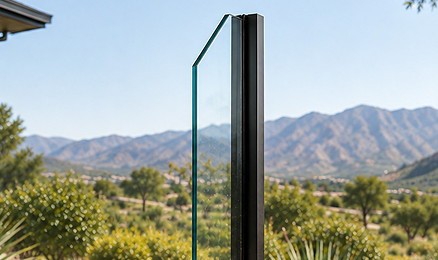
Single-pane
One layer of glass, no insulating gap. Common in older homes and the least efficient option. If you still have single-pane windows, this is where replacement pays off the most.
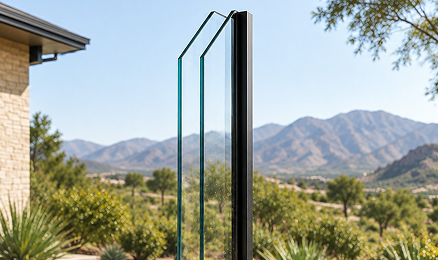
Double-pane
Two layers of glass with an insulating gap, usually filled with argon gas, and a Low-E coating. This is the standard for hot climates and the best balance of performance and cost for the vast majority of homes in our region.
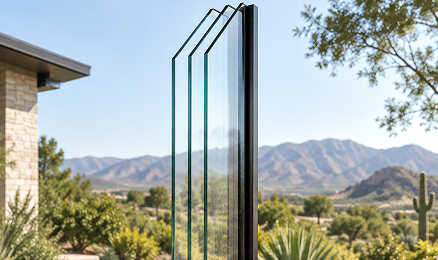
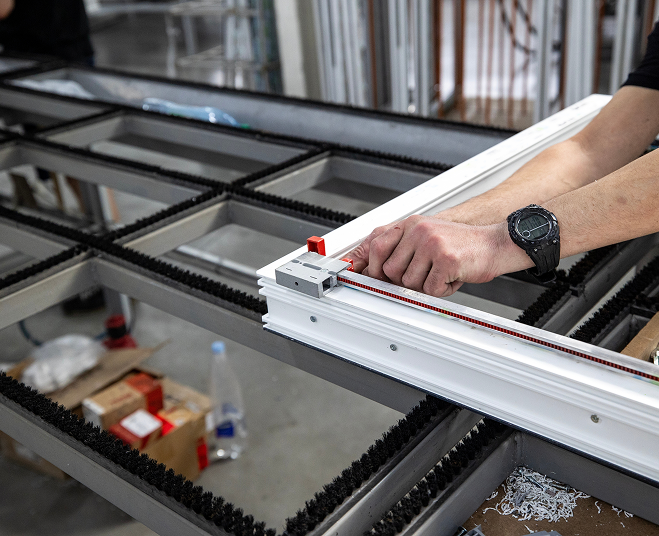
Triple-pane
Three layers of glass. They offer the best insulation, but the extra benefit is aimed mostly at very cold northern climates. In the desert, a quality double-pane window with a good Low-E coating and a low SHGC usually delivers nearly all the comfort and savings for less money.
Which frame material is best for a hot, sunny climate?
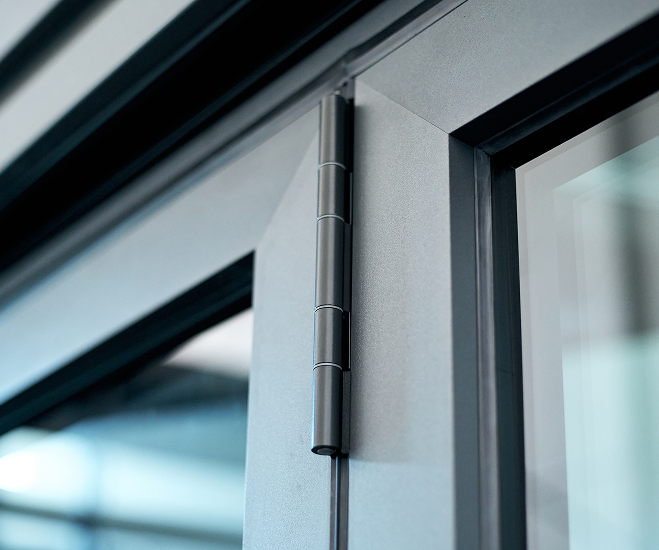
The frame matters as much as the glass, because some materials carry heat straight into your home.
- Vinyl — doesn't conduct heat, never needs painting, and holds up well against sun and dry heat. It's the most popular choice in our region for good reason: strong efficiency at a reasonable price.
- Fiberglass — extremely durable and stable in extreme temperature swings, with excellent insulation. A premium, long-lasting option.
- Wood — beautiful and naturally insulating, but needs more maintenance in a dry, sunny climate.
- Aluminum — strong and slim, but metal conducts heat readily, which makes bare aluminum a poor insulator for a hot climate unless it has a "thermal break" built in to interrupt the heat flow.
For most homeowners across Arizona, New Mexico, West Texas, and Southern California, vinyl or fiberglass frames paired with dual-pane Low-E glass give the best combination of comfort, durability, and value.

When you're comparing windows, look for:
- ENERGY STAR certified for the Southern or South-Central zone
- U-factor around 0.30 or lower
- Low-E glass coating
- Dual-pane construction with argon gas fill
- Vinyl or fiberglass frames (or thermally-broken aluminum)
- A reasonably high VT so rooms stay bright
Get those right and you've got a window built for our sun — not someone else's winter.
Are energy-efficient windows worth the cost?
IFor most homes in our climate, yes — especially if you're replacing single-pane or older aluminum windows. The savings come from lower cooling bills every summer, and the comfort benefit is immediate: no more hot spots by sunny windows, less fading of your interiors, and a quieter, more consistent indoor temperature.
There may also be federal tax credits and local utility rebates available for qualifying ENERGY STAR windows, which can offset part of the upfront cost. (For the current status of window and door tax credits, see our companion guide in the Guide Center.)
FREQUENTLY ASKED QUESTIONS ABOUT KITCHEN CABINETS
1. What is the best SHGC for windows in Arizona?
In Arizona and the rest of the Southern climate zone, look for an SHGC of 0.23 or lower. A low SHGC blocks more of the sun's heat, which directly reduces cooling costs in a hot, sunny climate.
2. What is the difference between U-factor and SHGC?
U-factor measures how well a window insulates against heat flowing through it, while SHGC measures how much of the sun's radiant heat the window lets in. In hot climates, SHGC is the more important of the two; in cold climates, U-factor matters most.
3. Do I need double-pane or triple-pane windows in a hot climate?
For most homes in the Southwest and Sun Belt, a quality double-pane (dual-pane) window with a Low-E coating and a low SHGC is the best value. Triple-pane windows are designed mainly for very cold northern climates and rarely pay off in the desert.
4. How much can energy-efficient windows save me?
ENERGY STAR estimates that replacing single-pane windows with certified energy-efficient windows lowers household energy bills by an average of up to 13% nationwide. In a cooling-dominated climate, most of that savings appears on your summer electric bill.
5. Are vinyl windows good for hot climates?
Yes. Vinyl frames don't conduct heat, resist sun and dry heat well, and never need painting, which makes them one of the most popular and cost-effective choices across Arizona, New Mexico, Texas, and Southern California.
6. What does the ENERGY STAR label mean for my area?
An ENERGY STAR certified window has been independently verified to meet the U-factor and SHGC targets for your specific climate zone. For The Window Depot's service area, that means the Southern zone (Arizona, New Mexico, Southern California) or the South-Central zone (West Texas).









How Can We Help?
COMPARE ITEMS
Quick View
{{product.item_name}}
Select Item For Bundle
{{attribute.value}}
{{attribute.value}}
{{{product.item_description}}}
- {{selling_point}}
| Location | Stock | |
|---|---|---|
| {{location.warehouse}} | {{location.quantity}} |
{{product.item_name}}
{{{product.item_description}}}
{{attribute.value}}
{{attribute.value}}
{{{product.item_description}}}
- {{selling_point}}
Configure your product
{{product.item_name}}
{{{ product.item_description }}}
Item Code: {{product.item_sku || ''}}